
The AI Gateway by Cequence was designed to solve one of the most concrete problems on the 2026 agenda: how to allow AI agents to access applications, APIs, data, and corporate systems without compromising authentication, authorization, visibility, governance, and protection. The solution aims to transform applications into AI-ready resources with MCP support, integrated identity, and operational controls suited for enterprise environments.
The adoption of Agentic AI is advancing because business leaders seek quick gains in efficiency, innovation, and competitive advantage. At the same time, these projects require access to corporate data to generate real value, shifting the conversation from experimentation to security architecture. In Cequence’s materials, this point is clear: companies are aggressively investing in AI infrastructure and internal efforts, but many initiatives start with implementation and only later recognize the need for governance, security, and safety.
For CISOs, CTOs, BISOs, architects, and risk leaders, this makes the issue urgent. The challenge is no longer just to adopt AI. The challenge is to enable agents to operate on corporate systems without creating uncontrolled connections, new abuse vectors, or a new layer of technical debt. This is precisely where Cequence gains strategic relevance.
Why AI Gateway has become a priority for companies wanting to use Agentic AI
The value of Agentic AI depends on access to applications, APIs, databases, SaaS systems, and legacy environments. Without this, the agent becomes an interesting but limited interface. With it, it can research, query context, execute actions, and automate entire workflows.
The problem is that direct connections between agents, LLMs, and corporate applications create a scenario of operational chaos and compliance risk. In the Cequence overview materials, this scenario is described as “uncontrolled chaos,” with three central adverse effects:
- Lack of visibility over who is using agents, which applications are being accessed, and which data is being retrieved
- Absence of consistent governance over how AI agents operate within the infrastructure
- Openings for abuse in monitoring, logging, rate limiting, and token usage
This framing is important because it translates a real market concern. Most organizations already have APIs and applications in production. What is lacking is not a technical interface. What is missing is a secure, controlled, and observable layer for agents to interact with these interfaces on a corporate scale.
What Cequence is proposing with the AI Gateway
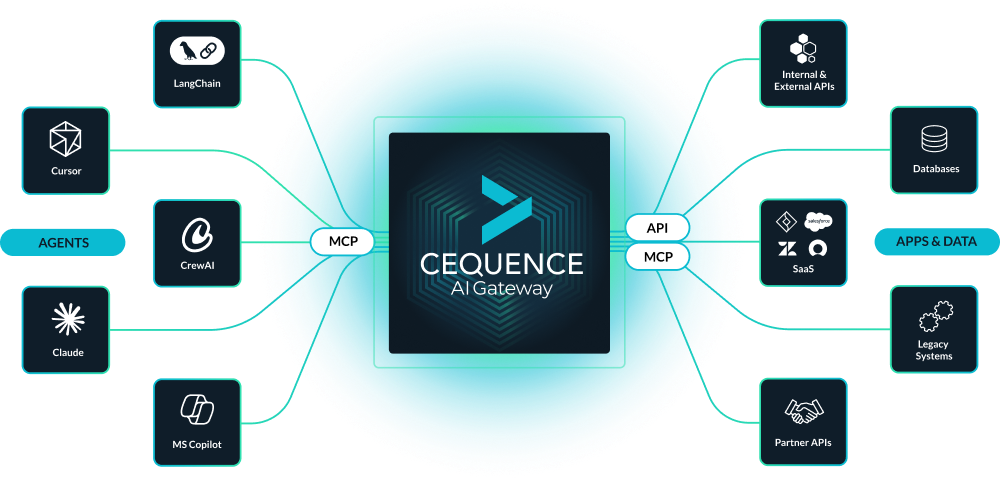
The positioning of the AI Gateway is quite straightforward: to be the easy, fast, and secure way to make applications AI-ready. In the solution’s material, Cequence shows that the gateway connects agents, LLMs, applications, and data through a centralized architecture, with integration to identity providers like Okta, Google, and Entra ID, capable of operating in SaaS or on-premises models.
In practice, this means that Cequence organizes the flow between:
- User
- Agent
- Language Model
- AI Gateway
- Identity Providers
- Corporate Applications and Data
This architecture matters because it shifts access from a direct and uncontrolled connection model to a mediating layer with authentication, tool control, and observability. Instead of the agent connecting freely to multiple systems, access goes through a structure designed for governance.
The real problem that the AI Gateway solves
Cequence organizes the challenges of AI adoption into three major requirements:
1. Enablement
Agents need access to applications and APIs. The problem is that development teams do not always have the skills or time required to create secure and reliable production solutions. It is also necessary to trust the MCP servers accessing apps and data.
2. Access control
It is essential to ensure appropriate access based on identity for users and agents, preventing unauthorized use of systems and data. This point is decisive because an agent with too broad access can pose an operational and exposure risk.
3. Monitoring and visibility
Companies need to know what agents and users are really doing. Without real-time visibility into communication, behavior, accessed APIs, and queried data, there is no adequate governance.
These three points summarize well the difference between an experimental AI project and a production-ready initiative. The AI Gateway by Cequence serves precisely as the layer that responds to these demands.
How Cequence’s architecture works in practice
The process is described in eight steps:
- the user sends a query
- the agent analyzes and routes the request
- the LLM interprets the query
- the agent makes tool calls
- authentication occurs
- tools access applications and data
- the agent formats the final response
- the user receives the response
This flow is important because it shows that Cequence is not treating Agentic AI as a simplistic integration between chatbot and backend. It is addressing the topic as a complete operational chain, in which authentication, tool calls, and application access must be controlled within a proprietary architecture.
The role of MCP without confusing the conversation
Cequence highlights support for MCP, Model Context Protocol, as a mechanism to transform APIs into tools accessible to agents. This is relevant, but needs to be interpreted correctly.
MCP is the interaction protocol. It does not alone solve the corporate requirements for identity, governance, and protection. The value of the AI Gateway lies in operationalizing this access with:
- trusted registration of MCP servers
- integrated authentication
- identity-based access control
- continuous monitoring
- guardrails and protection
This point is especially important because the market tends to confuse compatibility with enterprise readiness. The distinguishing factor of Cequence is not just in “speaking MCP.” It is in offering a layer of security and governance for this interaction model.
The most relevant capabilities of the AI Gateway for enterprises
Trusted MCP Server Registry
Users and agents start working with a trusted registry of MCP servers, reducing the risk of rogue servers. In a scenario where the misuse of connectors and MCP servers is already emerging as an abuse vector, this point is highly relevant.
Integrated Access Control
The solution offers access control based on OAuth 2.1 and integration with identity providers, enabling valid users and agents and blocking unauthorized use. The materials also mention support for machine identity, chatbots, and workflows.
Real-Time Monitoring, Guardrails & Protection
Cequence monitors identity and behavior of users and agents, access to applications, and API calls, allowing action when behavior exceeds predefined limits. For a corporate environment, this transforms the AI Gateway into a layer of observability and enforcement, not just integration.
Enterprise-grade operations
The solution features scalability, performance, reliability, continuous environment monitoring, distinct pre-production and production modes, and RBAC. This combination reinforces that the proposal is not just to enable a pilot but to provide operational support for AI adoption.
The authentication flow reinforces the corporate focus
One of the most solid points of Cequence‘s supplementary materials is the detailing of the MCP Auth Flow. In this flow, an agent like ChatGPT attempts to connect to the MCP server, receives an authentication challenge, and is redirected to Cequence‘s authentication server. The user logs in with the client’s corporate credentials, not with Cequence‘s proprietary credentials. After that, a second exchange occurs to obtain authorization with the target application, while the user’s tokens for the application are stored separately and are not sent to the user or the MCP client.
This point is particularly important for decision-makers. It shows that Cequence‘s model does not treat authentication as an operational detail, but as a central part of the architecture. Instead of creating a dangerous shortcut, the proposal is to preserve the use of corporate identity and properly segment access to the MCP server and target applications.
How Cequence connects AI Gateway to its API Security base
Cequence is already positioned by Nova8 as a Unified API Protection platform, covering discovery, inventory, compliance, auto-generated specs, abuse mitigation, bot management, and real-time fraud prevention. This remains true. The AI Gateway does not replace this category. It enhances Cequence’s relevance for the new corporate AI landscape.
The path of Cequence starts from Bot Management, evolves to API Security, and reaches AI Gateway, with over ten years of experience in application and API security supporting an architecture geared towards Agentic AI. It also stands out for its integration with the Cequence Unified Application Protection platform, which adds:
- comprehensive protection for APIs and applications
- generation of enriched specs for better and more predictable agent responses
- defense against agent-driven attacks, fraud, and exposure of sensitive data
- protection against AI-driven business logic abuse
This is essential for correctly positioning the solution. Cequence’s AI Gateway is stronger precisely because it is built on a mature base of API, application, and bot security.
What a CISO, CTO, or BISO should ask before enabling Agentic AI
Before connecting agents to corporate systems, some questions need to be answered objectively:
- who authenticates this agent and with what identity?
- what tools, endpoints, and applications can it access?
- how does the company monitor the behavior of the agent and the user?
- how to deal with trusted MCP servers and avoid rogue connectors?
- how to deploy this model without creating a new layer of risk?
- how to integrate this into an existing API security strategy?
If these answers are not yet clear, the conversation about AI Gateway ceases to be accessory and becomes structural.
Nova8’s role in this agenda
Nova8 officially distributes Cequence in Brazil and supports partners and clients in adopting modern API Security strategies, unified application protection, and new security demands related to Agentic AI. In the context of the portfolio, Cequence is Nova8’s solution for API discovery, governance, protection, bot mitigation, fraud, and abuse, and now extends its relevance with AI Gateway.
This is especially important for companies advancing in AI but who do not want to repeat a known market pattern: accelerating experimentation and then attempting to reorganize identity, governance, and monitoring. The correct conversation, for 2026, is to do this from the outset.
If your organization is evaluating how to connect Agentic AI to applications, APIs, and corporate data with real security, now is the right time to deepen the conversation about Cequence. The AI Gateway addresses a concrete market need: accelerating AI adoption without compromising identity, control, monitoring, and protection.
FAQ
What is an AI Gateway?
An AI Gateway is a layer that connects AI agents to applications, APIs, and corporate data with authentication, authorization, monitoring, and governance, allowing for safer and more scalable adoption of Agentic AI.
What does Cequence deliver with the AI Gateway?
The Cequence makes applications AI-ready with MCP support, integration with identity providers, reliable registration of MCP servers, access control, real-time monitoring, and enterprise-grade operation.
Does the AI Gateway replace API Security?
No. The AI Gateway does not replace API Security. In the case of Cequence, it relies on the Unified API Protection foundation and extends that capability to the new scenario of agent access.
What does MCP mean in this context?
MCP, Model Context Protocol, is the protocol used to expose tools and context to agents. The AI Gateway’s differentiator is to control this access with identity, governance, and monitoring.
In what type of company does this make more sense?
In organizations that already have APIs, SaaS applications, internal systems, and relevant corporate data and wish to enable Agentic AI with security, traceability, and operational control.